
Stock options offer a compelling avenue for investors to participate in the market’s potential gains and losses, but with a level of complexity that demands careful understanding. They represent a contract granting the right, but not the obligation, to buy or sell an underlying asset (typically a stock) at a predetermined price on or before a specific date. This nuanced approach allows for strategic maneuvering and leveraged returns, but also introduces significant risks if not managed properly.
This exploration delves into the core concepts of stock options, explaining their various types, pricing mechanisms, and inherent risks. We’ll compare them to direct stock ownership, examining the advantages and disadvantages of each approach. Furthermore, we’ll cover essential trading strategies and risk management techniques, equipping you with a foundational understanding of this powerful, yet intricate, investment tool.
Introduction to Stock Options
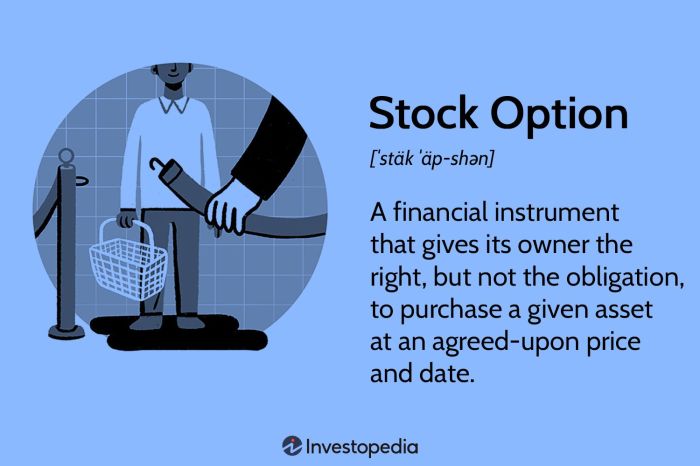
Stock options are financial contracts that give the buyer the right, but not the obligation, to buy or sell an underlying asset (like a company’s stock) at a predetermined price (the strike price) on or before a specific date (the expiration date). They’re essentially a bet on the future price movement of a stock. Understanding options requires grasping the core concepts of calls and puts.Options trading offers investors a powerful tool to manage risk and potentially profit from price fluctuations, significantly exceeding the possibilities available with simple stock purchases.
They are frequently employed by sophisticated investors to hedge against losses, speculate on price changes, or generate income.
Call Options
A call option grants the buyer the right tobuy* a specific number of shares of an underlying stock at a predetermined price (the strike price) before or on a specific date (the expiration date). If the stock price rises above the strike price before expiration, the buyer can exercise the option, purchasing the shares at the lower strike price and immediately selling them at the higher market price, realizing a profit.
If the stock price remains below the strike price, the buyer lets the option expire worthless, losing only the premium paid to purchase the option.For example, imagine a call option on Company XYZ stock with a strike price of $100 and an expiration date in three months. If the buyer paid a premium of $5 per share for the option and the stock price rises to $110 before expiration, the buyer can exercise the option, buying the shares at $100 and immediately selling them at $110, making a profit of $5 per share, minus the $5 premium, resulting in a net profit of $0.
However, if the stock price remains at $90, the option expires worthless, and the buyer loses the initial $5 premium.
Put Options
A put option grants the buyer the right tosell* a specific number of shares of an underlying stock at a predetermined price (the strike price) before or on a specific date (the expiration date). If the stock price falls below the strike price before expiration, the buyer can exercise the option, selling the shares at the higher strike price, thus limiting their losses.
If the stock price remains above the strike price, the buyer lets the option expire worthless, losing only the premium paid.For example, consider a put option on Company ABC stock with a strike price of $50 and an expiration date in two months. Suppose the buyer paid a premium of $3 per share and the stock price falls to $40 before expiration.
The buyer can exercise the option, selling the shares at $50 and limiting their losses to $3 per share (the premium paid). However, if the stock price remains at $60, the option expires worthless, and the buyer loses the $3 premium.
Real-World Scenarios of Stock Option Usage
Stock options are used in a variety of situations by different types of investors. Hedge funds might use options to hedge against potential losses in their stock portfolio. For example, if a hedge fund holds a large position in a particular stock, they might buy put options as insurance against a significant price drop. Individual investors may use options to speculate on the price movement of a stock, potentially generating higher returns than simply buying or selling the underlying shares.
A company might use employee stock options as a form of compensation, incentivizing employees to contribute to the company’s success. Finally, options are also used by sophisticated traders to generate income through strategies like covered calls or cash-secured puts.
Types of Stock Options
Stock options are not a monolithic entity; they come in various forms, each with unique characteristics impacting their value and suitability for different investment strategies. Understanding these distinctions is crucial for navigating the options market effectively. This section will explore the key differentiators between option types, focusing on the exercise timing, option styles, and popular trading strategies.
American, European, and Asian Options
The primary distinction between option types lies in when they can be exercised. American options offer the flexibility to be exercised at any time before the expiration date, while European options can only be exercised at expiration. Asian options, a more complex derivative, derive their value from the average price of the underlying asset over a specified period, rather than its price at a single point in time.
This averaging feature can reduce the impact of short-term price volatility. For example, an investor hedging against currency fluctuations might prefer an Asian option to mitigate the risk of adverse movements immediately before expiration.
Option Strategies
Numerous strategies leverage the unique characteristics of options contracts to achieve specific investment goals. Covered calls involve selling call options on shares the investor already owns, generating income while limiting potential upside. Protective puts, conversely, involve buying put options to safeguard against potential losses on a stock position. Straddles, a more complex strategy, involve simultaneously buying a call and a put option with the same strike price and expiration date, profiting from significant price movements in either direction.
The investor profits most if the underlying asset price moves significantly in either direction from the strike price by expiration. For instance, a straddle could be employed if an investor anticipates a large price swing before an important earnings announcement, irrespective of the direction.
Vanilla and Exotic Options
Options contracts are broadly categorized into vanilla and exotic options. Vanilla options, the most common type, are standardized contracts with clearly defined terms and readily available market liquidity. These are the American, European, and Asian options discussed previously. Exotic options, on the other hand, are customized contracts with non-standard features tailored to specific needs. These can include features like barrier options (activated only if the underlying asset price reaches a predetermined level), Asian options (as previously described), or lookback options (whose payoff depends on the highest or lowest price of the underlying asset during the option’s life).
The complexity and customization of exotic options generally mean lower liquidity and higher transaction costs compared to their vanilla counterparts. A company might use exotic options to hedge against complex risks, for example, a multi-year project dependent on commodity prices.
Option Pricing and Valuation
Option pricing is a complex field, but understanding the key factors that influence prices is crucial for successful trading. These factors interact in intricate ways, and accurately predicting option prices requires sophisticated models. This section will explore the major drivers of option value and introduce a widely used pricing model.Option prices are determined by a dynamic interplay of several factors.
The most significant of these are the price of the underlying asset, its volatility, the time until the option expires, and prevailing interest rates. Changes in any of these factors will lead to a recalculation of the option’s theoretical value.
Factors Influencing Option Prices
The price of the underlying asset has a direct impact on option value. For call options (the right to buy), a rising underlying asset price increases the option’s value, while a falling price decreases it. Conversely, for put options (the right to sell), a falling underlying asset price increases the option’s value, and a rising price decreases it. Volatility, measured by the standard deviation of the underlying asset’s returns, significantly affects option prices.
Higher volatility implies a greater chance of large price swings, increasing the value of both call and put options. Time to expiration is another crucial factor; options with longer maturities generally have higher values due to the increased potential for price fluctuations. Finally, interest rates influence option prices because they represent the opportunity cost of capital. Higher interest rates tend to increase the value of call options and decrease the value of put options.
The Black-Scholes Model
The Black-Scholes model is a widely used mathematical model for pricing European-style options (options that can only be exercised at expiration). It relies on several key assumptions, including that the underlying asset price follows a geometric Brownian motion, that options are European-style, that there are no dividends paid during the option’s life, that there are no transaction costs, and that the risk-free interest rate is constant.
The model uses these inputs to calculate a theoretical price for the option. While influential, it’s crucial to acknowledge its limitations. The assumptions underlying the model are often not perfectly met in the real world, leading to potential discrepancies between the model’s predicted price and the actual market price. For example, real-world asset prices often exhibit jumps and discontinuities not captured by the model’s continuous-time assumption.
Furthermore, the model’s assumption of constant volatility is frequently challenged by empirical evidence showing volatility clustering and changes over time.
Black-Scholes Model Inputs and Outputs
The following table summarizes the inputs and outputs of the Black-Scholes model.
| Input | Description | Output | Description |
|---|---|---|---|
| S | Current price of the underlying asset | C | Theoretical call option price |
| K | Strike price of the option | P | Theoretical put option price |
| T | Time to expiration (in years) | ||
| σ | Volatility of the underlying asset | ||
| r | Risk-free interest rate |
The Stock Market and Stock Trading
The stock market is a complex yet fascinating system where buyers and sellers trade shares of publicly listed companies. Understanding its mechanics is crucial for anyone considering investing in stocks, including those working with stock options. This section will cover the basic functions of the stock market, common order types, and the analytical approaches traders use to make informed decisions.The stock market functions as a centralized marketplace, primarily facilitated by exchanges like the New York Stock Exchange (NYSE) and Nasdaq.
These exchanges provide a regulated environment for trading securities, ensuring transparency and fair pricing. Investors buy and sell shares based on their expectations of a company’s future performance, influencing the price of the stock. This constant interplay of supply and demand determines the market price, creating a dynamic and often volatile environment.
Stock Market Orders
Different order types allow investors to execute trades based on their specific risk tolerance and investment strategies. Understanding these order types is vital for controlling the timing and price at which trades are executed.
- Market Orders: These orders instruct the broker to buy or sell a security at the best available price immediately. Market orders are simple to execute but carry the risk of slippage, where the actual execution price differs from the prevailing price at the time the order was placed, particularly during periods of high volatility.
- Limit Orders: A limit order specifies a maximum price (for a buy order) or a minimum price (for a sell order) at which the investor is willing to trade. This order type helps manage risk by preventing purchases above a predetermined price or sales below a certain threshold. However, there’s a risk the order may not be executed if the market price does not reach the specified limit.
- Stop Orders: Stop orders are designed to limit losses or protect profits. A stop-loss order triggers a market order when the price falls below a specified level, while a stop-limit order triggers a limit order when the price falls below a specified level. This helps to mitigate potential losses if the price moves unexpectedly against the investor’s position. It’s important to note that stop orders are not guaranteed to execute at the specified price, particularly in volatile markets.
Fundamental and Technical Analysis
Investors employ various analytical methods to assess the value and potential of stocks. Fundamental analysis and technical analysis represent two distinct but often complementary approaches.Fundamental analysis focuses on evaluating the intrinsic value of a company based on its financial statements, management quality, competitive landscape, and industry trends. Analysts examine factors like revenue growth, profitability, debt levels, and future prospects to determine whether a stock is undervalued or overvalued relative to its fundamentals.
For example, a company with strong earnings growth, low debt, and a robust market position might be considered fundamentally sound and attractive for investment.Technical analysis, on the other hand, uses historical price and volume data to identify patterns and trends that may predict future price movements. Technical analysts study charts, indicators, and other market data to identify potential trading opportunities.
They may look for patterns like support and resistance levels, moving averages, and candlestick formations to gauge momentum and predict future price direction. For example, a sustained upward trend in a stock’s price, coupled with increasing trading volume, might be interpreted as a bullish signal by technical analysts.
Illustrative Example
Understanding how options profit and loss works is crucial for successful trading. Let’s examine scenarios illustrating both profitable and unprofitable outcomes. These examples will focus on the mechanics of option trading, showing how the underlying asset’s price movement interacts with the option’s strike price and expiration date to determine the final outcome.
Profitable Call Option Scenario
Imagine Sarah buys a call option contract for 100 shares of XYZ Corp. The strike price is $50, and the option expires in three months. She pays a premium of $2 per share, meaning her total cost is $200 (100 shares x $2/share). Over the next three months, XYZ Corp. stock experiences a surge in price, rising to $65 per share.
Since the stock price ($65) exceeds the strike price ($50), Sarah’s call option is “in the money.” She can exercise her option, buying 100 shares at $50 each and immediately selling them at the market price of $65, making a profit of $15 per share, or $1500 total. Subtracting her initial premium of $200, her net profit is $1300.
Even if she chose not to exercise and sold the option itself, it would be worth significantly more than the initial $200 premium due to the increase in the underlying asset’s value.
Unprofitable Put Option Scenario
Let’s consider David, who buys a put option contract for 100 shares of ABC Company. The strike price is $75, and the option expires in two months. He pays a premium of $3 per share, totaling $300 (100 shares x $3/share). David believes the price of ABC Company will fall below $75 before the option expires. However, unexpectedly, ABC Company’s stock price rises to $85 per share by the expiration date.
This means David’s put option is “out of the money.” The option expires worthless, and David loses his entire premium of $300. He has no opportunity to profit, as the stock price remained above the strike price throughout the option’s life. The only time he would have made money is if the stock price had dropped below $72 before the expiration date (allowing him to sell the contract for a profit).
Understanding stock options requires grasping both their potential for significant returns and the inherent risks involved. While they offer leveraged opportunities not available through direct stock ownership, careful consideration of individual risk tolerance, market conditions, and appropriate trading strategies is paramount. This overview has provided a foundation for further exploration, highlighting the complexities and potential rewards of navigating the world of stock options.
Remember that thorough research and potentially seeking professional financial advice are crucial before engaging in options trading.
Question Bank
What is the difference between a call and a put option?
A call option gives the buyer the right to
-buy* the underlying asset at a specific price (the strike price) before a certain date. A put option gives the buyer the right to
-sell* the underlying asset at the strike price before a certain date.
How much can I lose trading stock options?
The potential loss depends on the specific strategy employed. Some strategies have limited risk (e.g., buying a put option), while others have unlimited risk potential (e.g., selling a call option without owning the underlying stock).
Are stock options suitable for beginners?
Stock options are generally considered more complex than buying or selling stocks directly and carry higher risk. Beginners should thoroughly educate themselves and potentially start with smaller trades or simulated trading before investing real capital.
Where can I learn more about stock options trading?
Numerous reputable online resources, books, and educational courses cover stock options. Always verify the credibility of your information sources.


