
Understanding call and put options is crucial for navigating the complexities of the stock market. These derivative instruments offer investors powerful tools for hedging risk, speculating on price movements, and generating income. While seemingly intricate, grasping the fundamental differences between calls and puts—their payoff structures and potential profit/loss scenarios—unlocks a world of strategic possibilities.
This guide delves into the core mechanics of call and put options, exploring their profit and loss profiles under various market conditions. We will examine popular option strategies that utilize both call and put options, such as straddles and strangles, and analyze the factors influencing their prices, including underlying asset price, volatility, time to expiration, and interest rates. Finally, we’ll address crucial risk management considerations to ensure informed and responsible options trading.
Profit and Loss Profiles
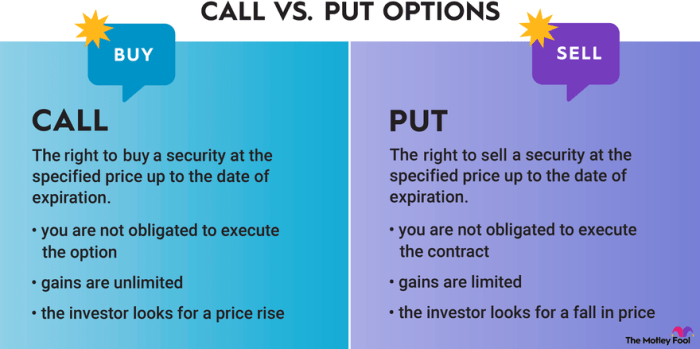
Understanding the profit and loss profiles of call and put options is crucial for effective options trading. These profiles illustrate how an option’s profit or loss changes based on the underlying asset’s price at expiration. The key difference lies in the trader’s expectation of the underlying asset’s price movement – upward for calls and downward for puts.The profit/loss profiles are significantly influenced by the option’s strike price, the premium paid, and the time until expiration.
As the underlying asset’s price moves closer to the strike price, the option’s value changes accordingly, affecting the potential profit or loss at expiration.
Call and Put Option Profit/Loss Comparison at Different Stock Prices
The following table illustrates the profit/loss profiles of a call and a put option with the same strike price and expiration date, under different scenarios of the underlying asset’s price at expiration. Note that the premium paid for both options is factored into the calculation. For simplicity, we assume a premium of $2 for both the call and the put option.
| Stock Price at Expiration | Call Option Profit/Loss | Put Option Profit/Loss | Explanation |
|---|---|---|---|
| $100 (Strike Price) | -$2 (Loss) | -$2 (Loss) | Both options expire worthless, resulting in a loss equal to the premium paid. |
| $105 | $3 (Profit) | -$2 (Loss) | The call option is in-the-money, generating a profit of $5 (intrinsic value) minus the $2 premium. The put option expires worthless. |
| $95 | -$2 (Loss) | $3 (Profit) | The call option expires worthless. The put option is in-the-money, generating a profit of $5 (intrinsic value) minus the $2 premium. |
| $110 | $8 (Profit) | -$2 (Loss) | The call option’s profit increases significantly as the stock price moves further above the strike price. The put option remains worthless. |
| $90 | -$2 (Loss) | $8 (Profit) | The put option’s profit increases significantly as the stock price moves further below the strike price. The call option remains worthless. |
Factors Influencing Maximum Profit and Maximum Loss
The maximum profit and loss potential for both call and put options are determined by several factors.For call options, the maximum profit is theoretically unlimited as the underlying asset’s price can rise indefinitely. However, the maximum loss is limited to the premium paid. For example, if you buy a call option for $2, your maximum loss is $2, regardless of how low the underlying asset’s price falls.For put options, the maximum profit is limited to the strike price minus the premium paid.
This occurs when the underlying asset’s price falls to zero. The maximum loss for a put option is also limited to the premium paid. For instance, if you buy a put option for $2 with a strike price of $100, your maximum profit is $98 ($100 – $2). Your maximum loss is again the $2 premium paid.
Maximum profit and loss are directly influenced by the option’s premium and strike price, and indirectly by market volatility and time until expiration.
Option Strategies Involving Calls and Puts
Options trading offers a wide array of strategies, and combining both call and put options allows for sophisticated approaches to managing risk and targeting specific market outlooks. These strategies provide flexibility beyond simply buying or selling calls or puts individually. Understanding their risk-reward profiles is crucial for successful implementation.Option strategies that simultaneously utilize both call and put options offer investors diverse ways to profit from various market scenarios.
These strategies can be used to capitalize on anticipated price volatility or to hedge existing positions. The complexity and potential profitability of these strategies increase, but so does the risk. Careful consideration of market conditions and individual risk tolerance is essential before employing them.
Straddles
A long straddle involves simultaneously buying a call and a put option with the same strike price and expiration date. This strategy profits most from significant price movements in either direction, making it suitable for traders anticipating high volatility. The maximum profit is theoretically unlimited for the long call, while the maximum loss is limited to the net premium paid for both options.
The break-even points are located at the strike price plus or minus the total premium paid. A short straddle, conversely, involves selling a call and a put with the same strike price and expiration date. This strategy profits from low volatility, as the maximum profit is limited to the net premium received. However, losses can be substantial if the underlying asset’s price moves significantly.
Strangles
A long strangle is similar to a long straddle, but the call and put options have different strike prices. The call option has a higher strike price than the put option. This strategy benefits from significant price movements, but requires a larger price move to become profitable compared to a straddle. The maximum profit is theoretically unlimited for the long call and the maximum loss is limited to the net premium paid.
The break-even points are located at the strike price of the call option minus the total premium paid and the strike price of the put option plus the total premium paid. A short strangle involves selling a call and a put with different strike prices, aiming to profit from low volatility, similar to a short straddle. However, the risk profile is slightly different due to the varying strike prices.
Implementing a Long Straddle
Before implementing any option strategy, thorough research and understanding of the market are crucial. A long straddle, for example, should only be undertaken when significant price movement is anticipated. The risk of substantial losses should be carefully weighed against the potential for significant gains. Furthermore, understanding the time decay of options is paramount.
- Step 1: Market Analysis: Identify an underlying asset expected to experience significant price volatility in the near future. Consider factors such as upcoming earnings announcements, significant news events, or other catalysts that might impact the price.
- Step 2: Option Selection: Choose a suitable expiration date for the options. Shorter expiration dates offer greater leverage but also accelerate time decay. Select a strike price that is close to the current market price of the underlying asset.
- Step 3: Order Placement: Simultaneously purchase a call option and a put option with the same strike price and expiration date. The quantity of contracts depends on your risk tolerance and capital allocation.
- Step 4: Monitoring and Management: Regularly monitor the price movements of the underlying asset and the options positions. Consider adjusting the position based on market changes or unforeseen events. Setting stop-loss orders can help limit potential losses.
- Step 5: Exit Strategy: Develop a clear exit strategy before entering the trade. This might involve closing the positions at a predetermined profit target or when the market conditions change significantly.
Factors Affecting Option Prices
Option pricing is a complex interplay of several key factors. Understanding how these factors influence the price of both call and put options is crucial for effective options trading. These factors are not independent; they interact dynamically to determine the final option price. A change in one factor will invariably affect the others, creating a constantly shifting landscape for option traders to navigate.
Underlying Asset Price
The price of the underlying asset (e.g., stock, index, commodity) has a direct and significant impact on option prices. As the price of the underlying asset increases, call option prices generally rise, while put option prices generally fall. Conversely, a decrease in the underlying asset’s price leads to a fall in call option prices and a rise in put option prices.
This relationship is intuitive: a higher underlying price increases the likelihood of a call option finishing in-the-money, and conversely, decreases the likelihood of a put option being in-the-money.
Volatility
Volatility, measured by the standard deviation of the underlying asset’s price, reflects the degree of price fluctuation. Higher volatility increases the chance of large price swings in either direction. This increased uncertainty benefits both call and put options. Higher volatility translates to higher option premiums for both calls and puts, as the potential for profit (and loss) increases. Conversely, lower volatility leads to lower option premiums.
Time to Expiration
The time until an option expires (time to expiration) significantly affects its price. As time to expiration decreases, the value of both call and put options generally declines. This is because there’s less time for the underlying asset’s price to move favorably to make the option profitable. This decay in value is known as time decay or theta.
Options with longer time to expiration offer more potential for price movement and thus command higher premiums.
Interest Rates
Interest rates play a less direct but still influential role in option pricing. Higher interest rates generally increase the value of call options and decrease the value of put options. This is because higher interest rates make holding the underlying asset more expensive, increasing the appeal of call options (which represent the right to buy at a specific price).
Conversely, higher interest rates make it less expensive to borrow money to buy the underlying, decreasing the value of put options (the right to sell).
| Factor | Effect on Call Option Price | Effect on Put Option Price | Explanation |
|---|---|---|---|
| Underlying Asset Price | Increases | Decreases | Higher underlying price increases the probability of the call being in-the-money, and vice-versa for the put. |
| Volatility | Increases | Increases | Higher volatility increases the potential for large price swings, benefiting both calls and puts. |
| Time to Expiration | Decreases | Decreases | Time decay reduces the value of options as expiration approaches. |
| Interest Rates | Increases | Decreases | Higher interest rates make holding the underlying more expensive, benefiting calls; conversely, borrowing to buy the underlying is cheaper, decreasing put value. |
Stock Market Context
Options contracts play a significant role in the stock market, offering investors and traders a wide array of tools to manage risk, speculate on price movements, and generate income. They are derivative instruments, meaning their value is derived from the underlying asset, typically a stock, index, or commodity. Understanding their mechanics and applications is crucial for navigating the complexities of modern financial markets.Options provide leverage, allowing investors to control a larger position with a smaller capital outlay compared to directly buying or selling the underlying asset.
This leverage, however, amplifies both potential profits and losses. This characteristic makes options suitable for both sophisticated and less experienced traders, but careful risk management is paramount regardless of experience level.
Options for Hedging
Hedging involves using options to mitigate potential losses from an existing position. For example, an investor holding 100 shares of XYZ stock at $50 per share might buy put options with a strike price of $45 to protect against a significant price drop. If the stock price falls below $45, the put options can be exercised to limit the loss.
The cost of the put options represents the insurance premium paid for this protection. The effectiveness of the hedge depends on factors such as the chosen strike price, expiration date, and the volatility of the underlying asset.
Options for Speculation
Speculation using options involves taking a directional bet on the price movement of the underlying asset. A bullish investor might buy call options, anticipating a price increase. If the price rises above the strike price before expiration, the call options can be exercised or sold for a profit. Conversely, a bearish investor might buy put options, expecting a price decline.
The potential profit from speculation is significantly higher than with hedging, but so is the risk of substantial losses if the price movement doesn’t align with the prediction. For example, a trader believing that ABC stock will rise significantly might purchase call options with a low strike price and a longer expiration date, aiming for substantial returns if their prediction proves accurate.
Options for Income Generation
Options can be used to generate income through strategies like selling covered calls or cash-secured puts. Selling a covered call involves owning the underlying stock and selling a call option against it. This generates income from the option premium, but limits the upside potential of the stock. Selling a cash-secured put involves having enough cash to buy the underlying stock if the option is exercised.
This strategy generates income from the premium, but carries the risk of having to buy the stock at the strike price if the option is assigned. For instance, an investor holding 100 shares of DEF stock might sell call options with a strike price slightly above the current market price to earn premium income while maintaining the underlying stock position.
Buying and Selling Options Contracts
Buying and selling options contracts involves interacting with a brokerage account. The process is similar to buying and selling stocks, but with some key differences. When buying an option, the investor pays a premium to acquire the right, but not the obligation, to buy (call) or sell (put) the underlying asset at a specific price (strike price) before a certain date (expiration date).
When selling an option, the investor receives a premium for taking on the obligation to fulfill the contract if the buyer exercises it. Commissions and fees vary depending on the brokerage and the volume of trades. These costs should be factored into the overall profitability analysis of any options strategy. Typically, commissions are a per-contract fee, while fees might be associated with specific services or account types.
Understanding these costs is crucial for accurate profit/loss calculations.
Risk Management in Options Trading
Options trading presents significant opportunities for profit, but it also carries substantial risk. Unlike stocks, where your maximum loss is limited to your initial investment, options trading involves the potential for losses exceeding the initial premium paid. Understanding and mitigating these risks is crucial for successful and sustainable trading. Effective risk management strategies are not just about limiting losses; they are about protecting your capital and allowing you to participate in the market over the long term.Options trading involves a complex interplay of factors, including underlying asset price movements, time decay (theta), implied volatility, and interest rates.
Each of these elements can impact the value of your options contracts, and unforeseen changes can lead to substantial losses if not properly managed. A thorough understanding of these dynamics, combined with a robust risk management plan, is essential for navigating the complexities of the options market.
Risk Tolerance Assessment
Before engaging in any options trading, it is paramount to accurately assess your risk tolerance. Risk tolerance refers to the level of potential loss you are comfortable accepting in pursuit of potential gains. This is a highly personal assessment and depends on various factors, including your financial resources, investment goals, and overall comfort level with market volatility. A common approach involves considering your investment timeline and the proportion of your portfolio you are willing to dedicate to options trading.
For example, a conservative investor with a long-term horizon might allocate a small percentage of their portfolio to options, focusing on strategies with defined risk profiles. In contrast, a more aggressive investor with a shorter time horizon might allocate a larger portion but accept a higher risk of loss. Failing to understand your risk tolerance can lead to impulsive decisions and potentially devastating losses.
Risk Management Techniques
Effective risk management in options trading relies on a combination of techniques that help control potential losses. These techniques are applicable to both call and put options, though their specific implementation might vary based on the chosen strategy.
- Defining Position Size: Never invest more capital in an options trade than you can afford to lose. This principle applies to all investments, but it’s especially critical in options trading due to the potential for rapid price movements. A common approach is to limit individual trade size to a small percentage of your overall trading capital, typically no more than 2-5%.
- Diversification: Don’t put all your eggs in one basket. Diversify your options portfolio across different underlying assets, expiration dates, and strategies. This helps to reduce the impact of any single losing trade on your overall portfolio performance. For example, instead of holding only call options on a single technology stock, diversify by also holding put options on a different sector or investing in options on an index fund.
- Stop-Loss Orders: These orders automatically sell your options contracts when the price falls to a predetermined level, limiting potential losses. This is a crucial tool for protecting against significant adverse price movements. The stop-loss level should be carefully chosen based on your risk tolerance and the specific characteristics of the trade. For example, a stop-loss order could be set at a price that represents a certain percentage loss from the entry price.
- Hedging Strategies: These involve using offsetting positions to reduce risk. For example, if you hold a long call option, you could hedge by simultaneously buying a put option with a similar strike price and expiration date. This strategy limits potential losses if the underlying asset price falls significantly.
- Monitoring and Adjustment: Regularly monitor your positions and adjust your strategies as needed. Market conditions can change rapidly, and it’s important to be proactive in managing your risk. This may involve adjusting stop-loss levels, closing positions early to secure profits, or implementing hedging strategies as circumstances dictate.
Importance of Understanding Risk Tolerance
Understanding your risk tolerance is not merely a suggestion; it’s a fundamental prerequisite for successful options trading. Ignoring this crucial aspect can lead to significant financial losses and emotional distress. A clear understanding of your risk tolerance helps you make informed decisions about which options strategies to employ, how much capital to allocate to each trade, and when to exit a position.
It allows you to develop a trading plan that aligns with your personal financial goals and risk profile, fostering a more disciplined and sustainable approach to options trading. By accurately assessing your risk tolerance, you can avoid emotional trading decisions driven by fear or greed, leading to better long-term outcomes.
Illustrative Examples
Understanding option payoffs requires visualizing different scenarios. The following examples demonstrate how call and put option profits and losses change depending on the stock price at expiration. We’ll examine several scenarios to illustrate the range of possibilities.
Option Payoff Scenarios at Expiration
The table below illustrates the payoff for both call and put options at various stock prices at expiration. We assume a strike price of $100 for both the call and put options. Remember, the payoff represents the profit or loss at expiration, excluding the initial premium paid for the option.
| Stock Price at Expiration | Call Option Payoff | Put Option Payoff | Detailed Explanation |
|---|---|---|---|
| $90 | $0 | $10 | The stock price is below the strike price. The call option expires worthless (0 payoff). The put option is in-the-money, resulting in a $10 payoff (Strike Price – Stock Price = $100 – $90 = $10). This represents the intrinsic value of the put. |
| $100 | $0 | $0 | The stock price equals the strike price. Both the call and put options expire worthless. There is no intrinsic value for either option. |
| $110 | $10 | $0 | The stock price is above the strike price. The call option is in-the-money, resulting in a $10 payoff (Stock Price – Strike Price = $110 – $100 = $10). The put option expires worthless (0 payoff). This represents the intrinsic value of the call. |
| $120 | $20 | $0 | The stock price is significantly above the strike price. The call option payoff increases proportionally to the difference between the stock price and the strike price ($120 – $100 = $20). The put option remains worthless. |
Mastering call and put options empowers investors to participate more effectively in the stock market. By understanding their unique characteristics, profit/loss profiles, and the impact of various market factors, one can develop sophisticated trading strategies tailored to their risk tolerance and financial goals. Remember, thorough research, diligent risk management, and a clear understanding of the market are essential for success in options trading.
This guide serves as a foundation for your journey into this dynamic and rewarding aspect of investing.
Question Bank
What is the difference between a buyer and a seller of a call option?
A call buyer has the right, but not the obligation, to buy the underlying asset at a specific price (the strike price) before a certain date (the expiration date). A call seller has the obligation to sell the underlying asset at the strike price if the buyer exercises their right.
What is the difference between a buyer and a seller of a put option?
A put buyer has the right, but not the obligation, to sell the underlying asset at a specific price (the strike price) before a certain date (the expiration date). A put seller has the obligation to buy the underlying asset at the strike price if the buyer exercises their right.
How do commissions and fees affect options trading profits?
Commissions and fees reduce the net profit from options trading. These costs should be factored into any profit/loss calculations and trading strategy.
What is an “in-the-money” option?
An option is “in-the-money” when its exercise would immediately result in a profit. For a call option, this means the market price of the underlying asset is above the strike price. For a put option, it means the market price is below the strike price.


